1:55
In this test, you'll hear a number of different recordings and you'll have to answer questions on what you hear.
2:02
There will be time for you to read the instructions and questions and you will have a chance to check your work.
2:10
All the recordings will be played once only.
2:12
The test is in four sections. Section one.
2:15
You will hear a man and a woman talking about travelling to an airport.
2:20
First, you have some time to look at questions one to five.
2:20
You will see that there is also an example which has been done for you.
2:26
Now, we shall begin.
2:27
You should answer the questions as you listen because you will not hear the recording a second time.
2:33
Listen carefully and answer questions one to five.
2:36
Good afternoon. Travel info. How can I help?
2:38
Oh, hi. I hope you can help me. I'm here in Chepstow at the moment and I need to get to Bristol Airport the day after tomorrow.
2:48
I was looking online at connections and I couldn't find too much useful information.
2:52
I mean, I'm actually very near the airport, no more than 40 kilometres, but public transport seems a bit limited.
2:59
Bristol Airport, okay? I'll see what I can come up with for you.
3:04
Sorry, where did you say you were?
3:06
Chepstow, that's C-H-E-P-S-T-O-W.
3:07
There's a train station here and I've been looking at the train times, but I've been struggling to understand them.
3:14
Taxi would probably be the fastest and easiest way.
3:17
It should take no more than 30 minutes or so from where you are right now.
3:22
Yes, but I was quoted between 55 and 70 pounds.
3:26
It's not the cheapest way, that's for sure. Let me see what other options there are.
3:31
Can I ask the time of your flight?
3:34
I want to make sure I get there at about 130 at the latest in the afternoon, that is.
3:40
My flight is actually at 325, although I should really be at the airport two hours earlier.
3:46
You've got a couple of other options then.
3:49
There isn't a boat is there.
3:51
I mean, there's a big river between here and Bristol.
3:54
It would be good if there was.
3:57
You can certainly get around Bristol City by boat, but getting to the airport is another matter.
4:02
The train is an option, but I wouldn't really recommend it.
4:06
Why not?
4:07
Well, it would involve catching one that leaves it at 11.29.
4:11
Goes to another town in the opposite direction where you need to wait for 50 minutes.
4:16
And then wait for a connection to head back towards Bristol.
4:20
It would end up taking nearly three hours in total, which I'm not sure is the most sensible choice.
4:26
And you'd still have to use a bus for the last part of your journey.
4:31
You'd get to the airport by 1340.
4:34
It would be a lot cheaper than the taxi though.
4:37
It's 17 pounds 10 for a single.
4:39
Otherwise, there's a bus service setting off at 11.05.
4:43
And you'd reach the airport at 12.44.
4:45
Okay, that's more than two hours before my flight leaves.
4:48
Well, there's another at 12.02, which also arrives about two hours later.
4:52
And that would be 16.40.
4:54
The time of arrival?
4:55
No, no, the price of the ticket.
4:58
Oh, I see.
4:59
Well, I think I'll take the earlier one just to be on the safe side.
5:04
Otherwise, I'd be petrified of missing my flight.
5:07
Before you listen to the rest of the conversation, you have some time to look at questions six to ten.
5:13
Now listen and answer questions six to ten.
5:16
Where does the bus leave from exactly?
5:19
The train station, I guess.
5:20
Actually, you can't catch the bus from there.
5:23
And Chepstone doesn't have a bus station as such.
5:26
You'll need to find the police station, which is just a few minutes walk up the hill from the town centre.
5:33
The buses arrive and leave from the same street.
5:36
Ask someone if you can't find it.
5:39
Or just ask where the buses leave from.
5:41
Right.
5:42
Okay.
5:42
Your bus service is T7.
5:44
Be careful about bus S7,
5:46
which goes in a completely different direction.
5:48
Both leave from stand one.
5:50
And don't worry, there are only about three or four stands, so you can't miss it.
5:55
Great.
5:56
So this will take me all the way to the airport?
5:59
Actually no.
6:00
You'll need to go all the way to the end stop, which is Marbra Street in Bristol.
6:06
Marbra?
6:06
That's N-A-R-L-B-U-R-G-H?
6:07
Not quite.
6:08
M-A-R-L-B-O-R-O-U-G-H.
6:08
Oh, I see.
6:09
Well, I was nearly right.
6:11
You'll need to change buses there.
6:13
Airport buses leave every ten minutes.
6:15
You can't miss them.
6:16
They'll have the name written on the side.
6:19
So something like the Bristol Airport Express?
6:21
Flyer, actually.
6:22
Which is funny, because buses don't fly.
6:24
And I won't have any problem taking all my things on board.
6:28
Well, you shouldn't have difficulty finding luggage space.
6:31
Because the buses leave so regularly, there are not going to be too many people on board.
6:37
Well, it sounds complicated, but at least it's cheaper than taking a taxi.
6:44
Thanks very much.
6:45
You're welcome.
6:47
Have a good trip.
6:50
That is the end of section one.
1:55
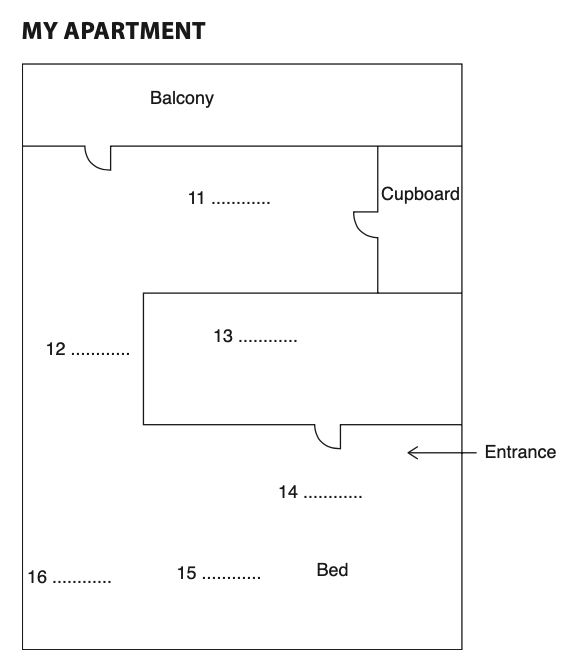
First, you have some time to look at questions 11 to 16.
1:59
Now listen and answer questions 11 to 16.
2:02
Hello everyone.
2:02
Very few of us have the luxury of being able to live in a spacious home with breathtaking
2:08
views from the window and a vast garden to relax in.
2:10
More likely than not, you'll live somewhere like I do.
2:13
A nice apartment in a pretty good location, but a lot more cramped than I'd prefer it
2:19
with narrow corridors and not much room for anything other than essential furniture.
2:21
But in this talk, I'd like to offer a few tips on making a small apartment feel as light
2:25
and airy as possible.
2:27
I'd like to show you this slide, which is a very simple plan of my own apartment.
2:32
As you can see, it's not too big, it's something like 40 square meters.
2:37
But I've tried to make the most of it.
2:40
As you come in, you'll basically come into what is now my bedroom, but you probably won't
2:45
notice it because I've put a lovely secondhand piece of furniture there, stacked my books
2:51
on it, of course, along with some other things, and it totally blocks the view of my bed on
2:57
the left.
2:58
It stretches most of the way up to the ceiling, and it basically creates a kind of wall.
3:04
Apart from a sense of privacy, it also means I don't have to look at the door to the bathroom
3:11
while I'm in bed.
3:12
So I've essentially created an extra corridor.
3:14
I work from home occasionally, and I couldn't think of where I'd put a large desk, so what
3:20
I've done instead is install a folding one on the wall, which lifts up whenever I'm not
3:26
using it.
3:27
It's in front of the bed, and rather than a desk chair, I use a trunk to sit on whenever
3:34
I'm working.
3:34
That's permanently there in front of my desk.
3:37
It's okay as long as I'm not sitting on it for hours, and it's really useful for extra
3:43
storage too.
3:44
My kitchen area is in an awkward place.
3:47
As you come right from the bedroom area, and towards what I call the living room area,
3:52
there's certainly no room for tables or chairs there, which is why I often have breakfast
3:58
standing up.
3:59
Then there's the balcony, where I have managed to put some chairs and a table.
4:04
It's quite a big amount of space, and good for sitting and having a meal with one or two
4:10
friends when the weather's okay.
4:12
All I have in the living room area at the moment is an armchair.
4:17
There's actually room for a small table and a lamp, and I'd like to add those later.
4:22
I don't think there's any need for a sofa when it's just me living there.
4:27
Before you listen to the rest of the talk, you have some time to look at questions 17-20.
4:34
Now listen, and answer questions 17-20.
4:36
First of all, don't spend your time wishing that you had a separate room for an office or
4:38
whatever.
4:39
It's perfectly easy to turn a single room into different zones.
4:40
This is what I did with my bedroom, which now has a corridor, a sleeping area, and a working
4:45
area.
4:46
You don't need to use a large bookshelf to achieve this, though.
4:47
Some large plants may work well to split up an area, or even some well-placed rugs in
4:53
different colors if you want to make things feel warm and cozy.
4:57
Another trick, which always works well, is to use mirrors to create the illusion of depth.
5:02
I have quite a big one in my bathroom, which really helps.
5:09
There are some places where it would be a terrible idea to place one, of course, like right
5:15
in front of where you sleep.
5:17
However, pictures and mirrors achieve the same effect.
5:19
I have a poster in front of my entrance door, which is the first thing I see when I come
5:26
home.
5:27
Another good trick is to avoid placing your furniture, especially things like sofas, large
5:31
tables, or beds, so that it goes right up against the walls.
5:35
It can actually give a much more spacious feeling if furniture kind of floats in the middle
5:42
of a room.
5:44
And while I'm on the topic of furniture, choose the style carefully.
5:50
Glass can be an interesting material for things like tables.
5:54
The one in my living room area is made from this, and looks a lot more airy than something
6:01
made of heavy looking wood or metal.
6:04
Similarly, my balcony tables and chairs, which are actually made from wood, can fold up and
6:12
be put aside when I'm not using them.
6:16
Finally, and this might seem like another obvious point, but it's an important one.
6:23
If you have the choice of painting the walls, don't try and be too creative when it comes
6:29
to lots of interesting, exciting colors.
6:33
Go for lighter, neutral colors instead.
6:37
Otherwise, you'll really make your place seem a lot darker and smaller than it needs
6:43
to be.
6:44
This is especially so with ceilings, which always seem to be a bit further away the paler
6:51
they are, so choosing the right color for those is a must.
6:56
Thank you for listening.
6:57
Now if you've got any questions or even tips of your own, then I'd be pleased to...
7:05
That is the end of section 2.
1:55
Section 3.
1:56
You will hear a student and a teacher talking about a dissertation.
2:00
First, you have some time to look at questions 21 to 25.
2:04
Now listen and answer questions 21 to 25.
2:06
Hello, Professor Jaworski.
2:06
Hi, Dora.
2:07
You wanted to talk about your dissertation?
2:10
That's right.
2:14
The deadline for submitting my idea is coming up soon, and I'm not really sure what I should
2:20
focus on.
2:21
Hmm.
2:21
Yes, you haven't got long left.
2:23
You brought up something in a lecture recently.
2:26
The linguistic landscape.
2:27
It sounded interesting.
2:28
Ah, yes.
2:29
It's a relatively new area of research.
2:31
Basically, it's how a particular language or group of languages is visible in a particular
2:33
space.
2:33
There's been a lot written about it if you want to read up on it.
2:38
Yes.
2:39
Thanks.
2:39
Knowing some of the people who've contributed the main ideas would be useful.
2:44
Well, Landry and Borhis would be a good place to start.
2:47
They were the first to come up with a clear idea of what the linguistic landscape was
2:53
back in 1997, focused especially on road signs, street names, adverts, shop signs.
2:58
They did research in Canada, which of course has a bilingual cultural background.
3:03
It's a place where two languages are spoken.
3:06
There you can see French and English all around you, because Canada is, historically, where
3:11
both French and English speakers have lived together.
3:13
So in Canada, you can tell that it's both a French and English area and culturally diverse
3:19
because of what you can see around you in the public space.
3:23
Sure.
3:24
And many researchers have built upon this.
3:26
Spolsky and Cooper, for example, made it clear that the linguistic landscape is something
3:31
that changes over time, depending on who moves in and out of an area.
3:36
Or how important people feel a certain language to be.
3:39
Okay.
3:40
Thanks.
3:40
Any other researchers I could look into?
3:43
There's Peter Backhouse.
3:44
He's done some interesting work in Tokyo, where he noticed not just Japanese signs everywhere,
3:49
but a lot of English signs too.
3:51
Now what does that tell you?
3:53
That Tokyo is a place where lots of Japanese and English-speaking people live.
3:58
Or that people they're just like English?
4:00
Exactly.
4:00
Fewer than 30% of Japanese people speak any English, but nevertheless, it has prestige there.
4:06
You mean like a special value?
4:08
That's right.
4:08
Other researchers have looked extremely carefully at multilingual signs.
4:11
For example, Skolan and Skolan came up with a theory of geosemiotics, which is to say,
4:17
they analyzed how language appears when it's put into a public space.
4:21
If you've got a sign with two languages on it, which comes first?
4:25
Are both languages written in text the same size?
4:28
Are the fonts different?
4:30
So everything can give you clues as to which language is more important to the people who put
4:36
the signs up.
4:37
Yes.
4:37
And it's not only about signs, essentially language is being displayed around us all the time.
4:43
Whether we notice it or not, researchers like Copeland have even studied the languages that
4:48
people wear on t-shirts.
4:49
And is that important?
4:51
Yes.
4:51
The languages we choose to wear, and therefore to display, can give us lots of information
4:56
about our feelings towards them.
4:58
Before you listen to the rest of the talk, you have some time to look at questions 26-30.
5:04
Now listen and answer questions 26-30.
5:06
I think this is something I'd really like to do some kind of research into.
5:08
I guess the first thing I need to do is to start thinking about all the languages I can
5:15
see around me here.
5:16
If I were you, I'd select a location first.
5:19
As you're not doing a huge piece of research, you could choose somewhere relatively small,
5:26
like the main shopping street here in the city, or somewhere that tends to have a higher number
5:32
of international visitors, like the airport.
5:34
OK, maybe the airport would be a good idea.
5:37
The next step would be to focus on what type of data you want to collect.
5:44
You could go for a quantitative approach in which you select all the signs in a particular
5:50
area, and then count the number of languages you find, then your research could simply indicate
5:55
which languages are most common.
5:57
You could support the data you collect with maps and photos.
5:59
To be honest, most studies into the linguistic landscape are like this because it's the
6:03
easiest type of data to collect, and the research can be very objective.
6:08
What about a qualitative approach?
6:11
Well, there are two different things you could do here.
6:15
One is to look carefully at signs, especially signs in more than one language, and ask
6:21
questions about the designs you can see.
6:24
Which language looks more official or more permanent?
6:29
Where are the different languages displayed?
6:31
If there are two languages on a sign, are they both exact translations?
6:38
What's the other thing I could do?
6:41
Probably most difficult of all, but worth trying.
6:44
You could interview people and ask if they have positive attitudes about the signs around
6:50
them.
6:51
Do they identify with them?
6:54
Are they happy about the number of languages on display?
6:58
Would they like more?
6:59
Have they even noticed what languages are on the signs?
7:04
One interesting thing would be to find out whether or not people feel like outsiders because
7:10
of the languages that are on display.
7:13
Hmm.
7:14
Okay.
7:15
Thank you.
7:16
I've got a lot to think about now.
7:19
I think the first thing to do would be to start studying the subject in detail.
7:25
Great.
7:25
I should be able to email you an initial reading list sometime later today.
7:32
That is the end of section 3.
1:55
First, you have some time to look at questions 31 to 40.
1:59
Now listen and answer questions 31 to 40.
2:03
Hello everyone and thanks for coming.
2:05
Now, some of you might not think that you're impatient people.
2:09
You rarely, if ever, get furious or upset about things.
2:12
But I can guarantee that for every single one of us,
2:16
there are things which annoy you regularly.
2:19
Getting annoyed is part of human nature.
2:21
But what kind of things make us annoyed
2:24
and what's the scientific explanation for it?
2:26
First of all, there are plenty of things in modern life
2:30
that are incredibly annoying.
2:30
From pop-up ads to being asked to make it through a test
2:34
to prove you're not a robot when you try to get onto a web page.
2:38
But there are plenty of old-fashioned things too.
2:41
People blocking an escalator at the exact point
2:43
when you have just one minute left to catch your train.
2:47
Or people who open their mouths while chewing their food
2:50
are just two out of thousands of things
2:53
that we might find irritating.
2:55
In short, there seem to be an endless number of things
2:59
to get annoyed about.
3:00
I would probably go as far as to say
3:03
that getting annoyed is the most common emotion of all.
3:06
So let's look at this emotion a little more scientifically.
3:10
We cannot say that we are all annoyed by exactly the same things.
3:14
For example, for one person, a selfie stick
3:17
might be a perfectly handy device,
3:19
well worth taking with you on holiday.
3:21
For someone else, seeing someone with this gadget
3:24
might drive them crazy.
3:25
In addition, there are almost certainly cultural differences
3:28
when it comes to what is annoying.
3:31
Someone raised in Britain, for example,
3:33
is unlikely to greet an assistant or owner when entering a shop.
3:37
In other countries, it would be quite rude not to.
3:40
There may also be medical reasons.
3:42
For people with a condition known as misophonia,
3:45
certain noises like fingers tapping on a keyboard
3:48
or someone eating crisps can trigger very strong reactions.
3:51
But perhaps we can say that there are some general rules
3:54
as to what makes us annoyed.
3:56
Scientists Joe Palka and journalist Flora Lixman
3:59
have written a book about this subject
4:01
which sets out three of those rules.
4:03
The first is that the annoying thing, whatever it is,
4:07
must be unpleasant without actually being physically harmful.
4:10
For example, an angry wasp flying around your room
4:13
wouldn't actually be annoying.
4:14
You know that you're somewhat at risk from a wasp.
4:17
Not so a fly would seem endlessly attracted
4:20
to circling around the middle of your room,
4:23
completely ignoring the window you kindly left open for it.
4:26
Secondly, to be annoying,
4:28
something needs to be as unpredictable as possible,
4:30
and it must also be intermittent,
4:32
which means that it continually stops and starts again.
4:35
Permanently slow wi-fi is something you can probably get used to.
4:39
If you know you have slow wi-fi,
4:42
you'll learn not to depend on it.
4:44
But normally good wi-fi that suddenly stops
4:46
when you're in the middle of something
4:49
and keeps on stopping at surprising moments
4:51
can really get on our nerves.
4:53
And here is a final rule.
4:55
Imagine that you order something online.
4:57
You get an email saying that it will arrive on Saturday
5:01
after 9am.
5:02
Excitedly, you wake up on Saturday morning
5:04
looking forward to your delivery.
5:06
Time passes and keeps on passing.
5:08
Before you know it, it's 1pm
5:10
and you have absolutely no idea how much longer you have to wait.
5:14
It could be five minutes or five more hours.
5:17
After 9am begins to seem like it could mean anything.
5:21
Basically, for something to be truly annoying,
5:23
it has to keep going for an unknown length of time.
5:27
So getting annoyed is extremely common.
5:29
But is there a way to get over it
5:32
and live a life free of always continually getting
5:35
slightly angry about things?
5:36
Annoyingly, the answer seems to be no.
5:39
That is the end of the test.